Table of Contents
The Septic Interval Cheat Sheet
If you don't want to do the math, use these 2024 industry standards:
- 1-2 people (1,000 gal tank): every 5-7 years.
- 3-4 people (1,000 gal tank): every 3-4 years.
- 5+ people (1,000 gal tank): every 2 years.
- Any home with a garbage disposal: cut the above times in half.
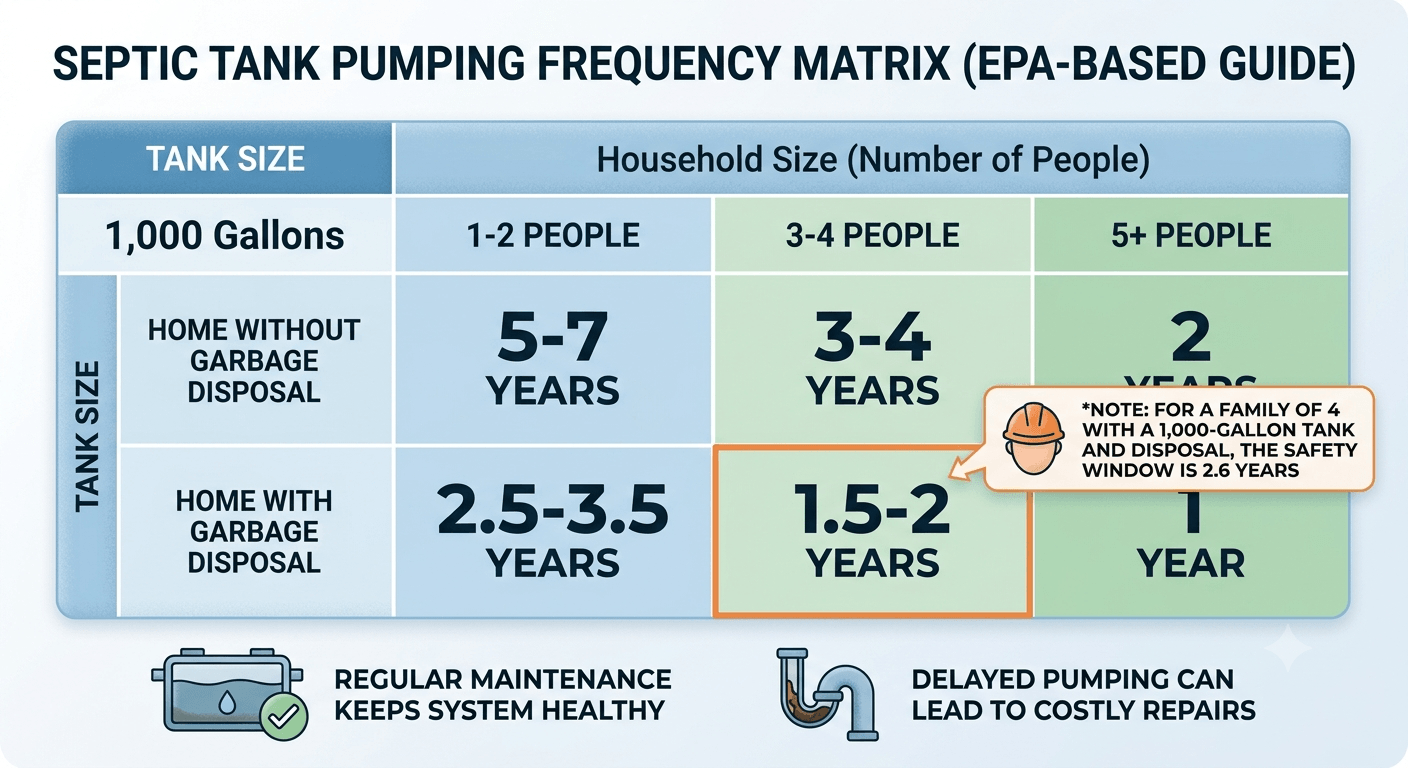
Recommended septic tank pumping interval (in years) based on EPA data. For a family of 4 with a 1,000-gallon tank, the safety window is 2.6 years.
According to EPA (Environmental Protection Agency) standards and local health regulations, a 1,000-gallon tank for a family of four hits its critical limit in about 2.6 to 4 years [1][2][6]. If you wait longer, you're gambling with your drainfield (the area of soil that filters liquid waste).
The Silent Catastrophe: Why "No Smell" Doesn't Mean "No Problem"
In my three decades of work, the most expensive phrase I've heard is: *"But it wasn't smelling, so I thought it was fine."*
A septic tank is a simple separation machine. Heavy solids, or sludge, sink to the bottom. Light fats and oils, known as scum, float to the top. The clear water in the middle, called effluent, is what flows out to your drainfield.
When the sludge gets too high, that "clear" water isn't clear anymore. It starts carrying bits of grit and waste into your filtration pipes. You won't smell a thing while this is happening, but those pipes are slowly choking to death.
Once those solids hit the soil in your drainfield, the damage is often irreversible. Pumping the tank is the only way to "drain the old oil" before it ruins the whole machine.
5 Factors That Speed Up the Clock
Not every household is the same. I've seen 1,500-gallon tanks fill up in two years because the owners treated the drain like a trash can.
1. The Garbage Disposal Factor: if you use a disposal, you're essentially doubling the load. Food scraps don't break down like human waste; they sit there as dense sludge. Research shows disposals increase solids by up to 90% [4].
2. Household Size: it's simple math. More people means more flushes and more showers. A system built for two will fail under a family of five.
3. Water Volume: high-efficiency appliances help. If you have leaky toilets or do 10 loads of laundry in one day, you're flooding the tank and pushing solids out before they can settle.
4. System Age and Soil Type: older tanks or those in heavy clay soil don't process waste as efficiently as newer systems in sandy, well-draining ground.
5. Seasonal Stress: I always tell my neighbors to schedule maintenance in the autumn. In the spring, high water tables (underground water levels) can put pressure on an empty tank. In the fall, you're clearing the deck before winter cold slows down the natural bacteria.
Red Flags: How to Tell if Your Tank is Screaming for Help
You don't need a degree in engineering to spot a failing system. You just need to use your senses:
- The "Gurgle": if your pipes make a glugging sound when you flush, that's air trapped by high liquid levels.
- The Lush Patch: if one part of your lawn is suspiciously green and vibrant, that's not a green thumb; that's your grass "drinking" raw sewage leaking from the system.
- Slow Drains: if every sink in the house is slow, the problem isn't a clog—it's a full tank.
- Standing Water: if you see puddles over the drainfield when it hasn't rained, your system has already failed.
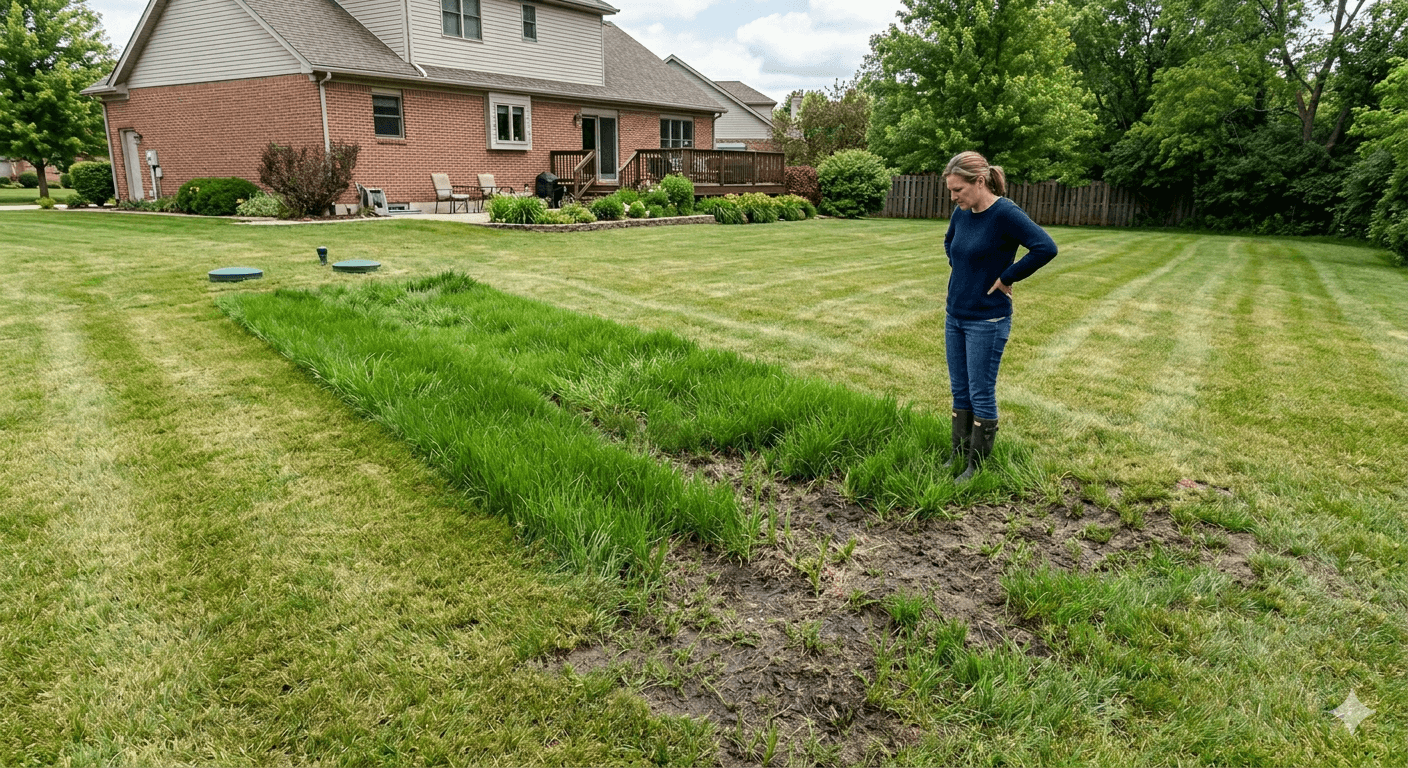
If you see standing water or "super-green" grass over your drainfield, call a pumper immediately.
The Math: $300 Now or $20,000 Later
Let's talk straight about money. A professional pump-out in 2024 will run you between $200 and $600 depending on your region and tank size [5]. If you do that every four years, it's about the cost of a couple of pizzas a year.
If you skip it and ruin your drainfield? You're looking at excavation, new permits, and a bill between $15,000 and $30,000 [7]. As a retired plumber, I'm telling you: take the $300 "insurance policy."
Safe DIY vs. The "Hard No"
I'm all for homeowners fixing a leaky faucet, but you need to know where the line is drawn.
What you CAN do (Safe DIY):
- Locate the lids: find your "as-built" drawing (the blueprint of your system) and clear the dirt off the covers.
- Inspect the area: check for the "lush patches" or odors mentioned above.
- Keep a log: write down every time the tank is serviced.
What you CANNOT do (The Hard No):
- Never lean into or enter a tank: gases like hydrogen sulfide and methane can knock you unconscious in one breath.
- Never pump it yourself: you lack the high-powered vacuum and the legal manifest required to dispose of biohazardous waste.
- Avoid "miracle" additives: most powders are a waste of money. Your tank has all the bacteria it needs. Some additives even liquefy sludge just enough to let it flow into and ruin your drainfield [9].
In states like Florida or Massachusetts, you need official maintenance records to sell your home [4][2]. Without a manifest from a licensed pumper, you could face fines up to $3,000 [8].
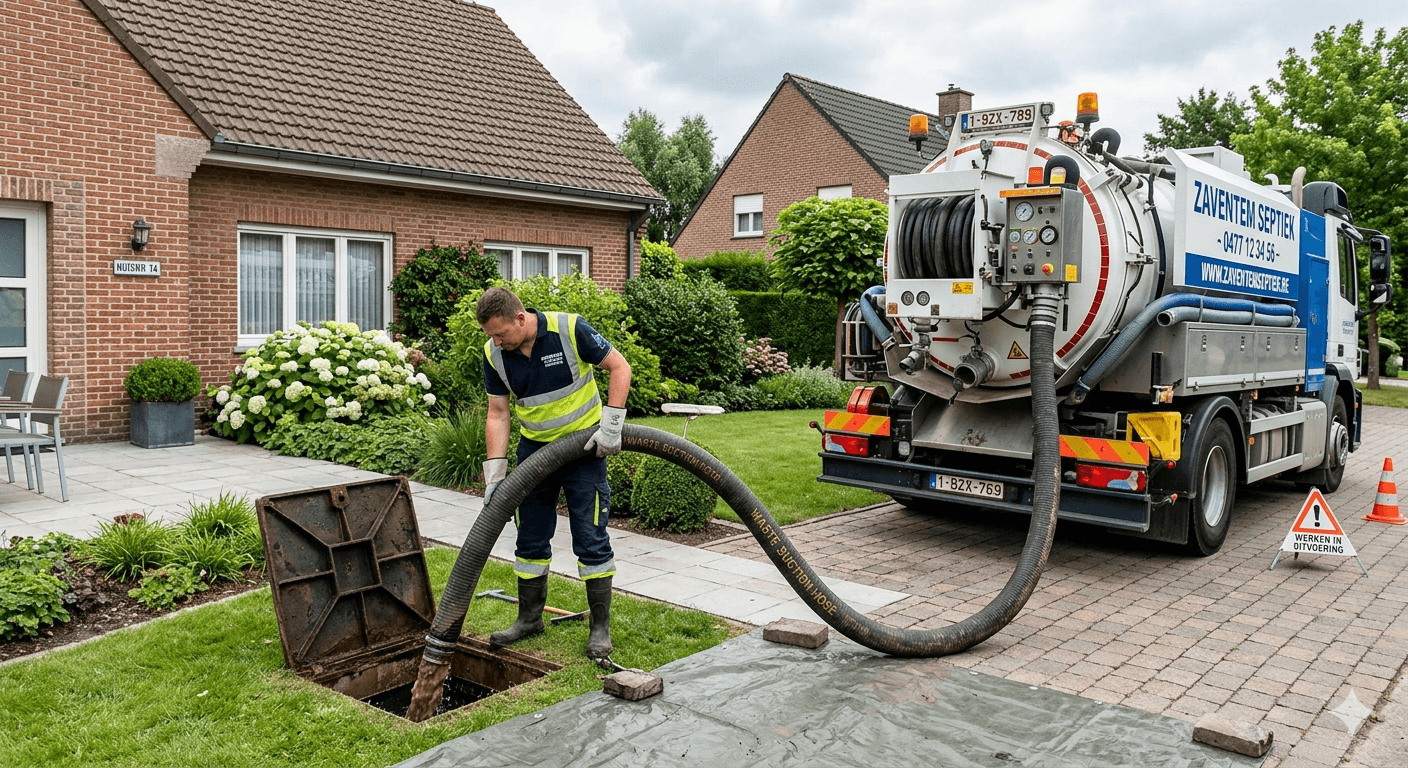
Professional pumping involves vacuuming heavy sludge and checking EPA-mandated levels (12 inches for sludge, 6 inches for scum).
Your Emergency Action Plan
If you aren't sure where your system stands, follow this priority list:
Scenario A: Everything seems fine, but I don't know the last pump date.
- Action: find your lids and schedule a routine inspection within the next 30 days.
Scenario B: I have slow drains or occasional "gurgling" sounds.
- Action: call a professional pumper this week. Stop using the garbage disposal and limit laundry until they arrive.
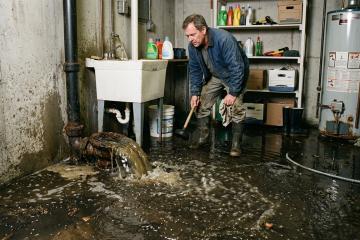
Scenario C: I see standing water or sewage backing up into the house.
- Action: this is a plumbing emergency. Stop all water use immediately and call for emergency service today.
FAQ
How often for a family of 4?
Every 2.6 to 4 years for a 1,000-gallon tank. If you have a garbage disposal, aim for the 2-year mark [6].
Can I use bleach?
A little is fine for laundry. But don't dump a whole gallon down the drain; it kills the "good" bacteria that keep the system working [10].
How long does it take?
A pro can usually get it done in 45 minutes if they don't have to spend an hour digging to find your lid [11].
I've seen a lot of good people lose a lot of money because they ignored a concrete box buried in their backyard. Don't be that person. A septic system isn't a "set it and forget it" appliance; it's a living filter that protects your home and your family's health. Treat it with a little respect, keep your receipts, and you'll sleep a lot better knowing your drains—and your bank account—are safe.
References
[1] EPA Homeowner Guide to Septic Systems — https://webgen1files.revize.com/modocenvironmental/Forms/2020/EPA%20septic%20system%20Homeowner%20Guide.pdf
[2] EPA Frequent Questions on Septic Systems — https://www.epa.gov/septic/frequent-questions-septic-systems
[3] Mass.gov: Caring for your Septic System — https://www.mass.gov/guides/caring-for-your-septic-system
[4] Miami County: High-Organic Strength Wastewaters (Garbage Grinders) — https://www.miamicountyin.gov/DocumentCenter/View/980/High-Organic-Strength-Wastewaters-Including-Garbage-Grinders-Fact-Sheet-PDF
[5] Cost of Septic Maintenance 2024 — industry average data
[6] SepticCalculator.com: Pumping Schedule — https://septiccalculator.com/calculator/pump-schedule
[7] Replacement Costs Data (US/FL) — estimated repair ranges 2024
[8] Environmental Fines (Comparative Analysis) — regional regulatory data
[9] Scientific Status of Septic Additives — waste management research
[10] Chlorine Neutralization Guidelines — chemical impact studies
[11] Standard Service Timeframes — professional service benchmarks