We have seen this technology save homeowners thousands in restoration costs, and this guide breaks down exactly how it works, what it costs, and when it should—or shouldn't—be used.
Table of Contents
- The 30-Second Gut Check: Is Your Pipe a Candidate?
- The Two Heavy Hitters of Trenchless Repair
- Compliance & Engineering: Doing it by the Book
- Trenchless vs. Traditional: The Hard Truth
- What Will This Cost? (2025-2026 Estimates)
- The Math of Reliability: Why Polymers Win
- How to Protect Your Investment
- What to Do Next: Your Action Plan
- References
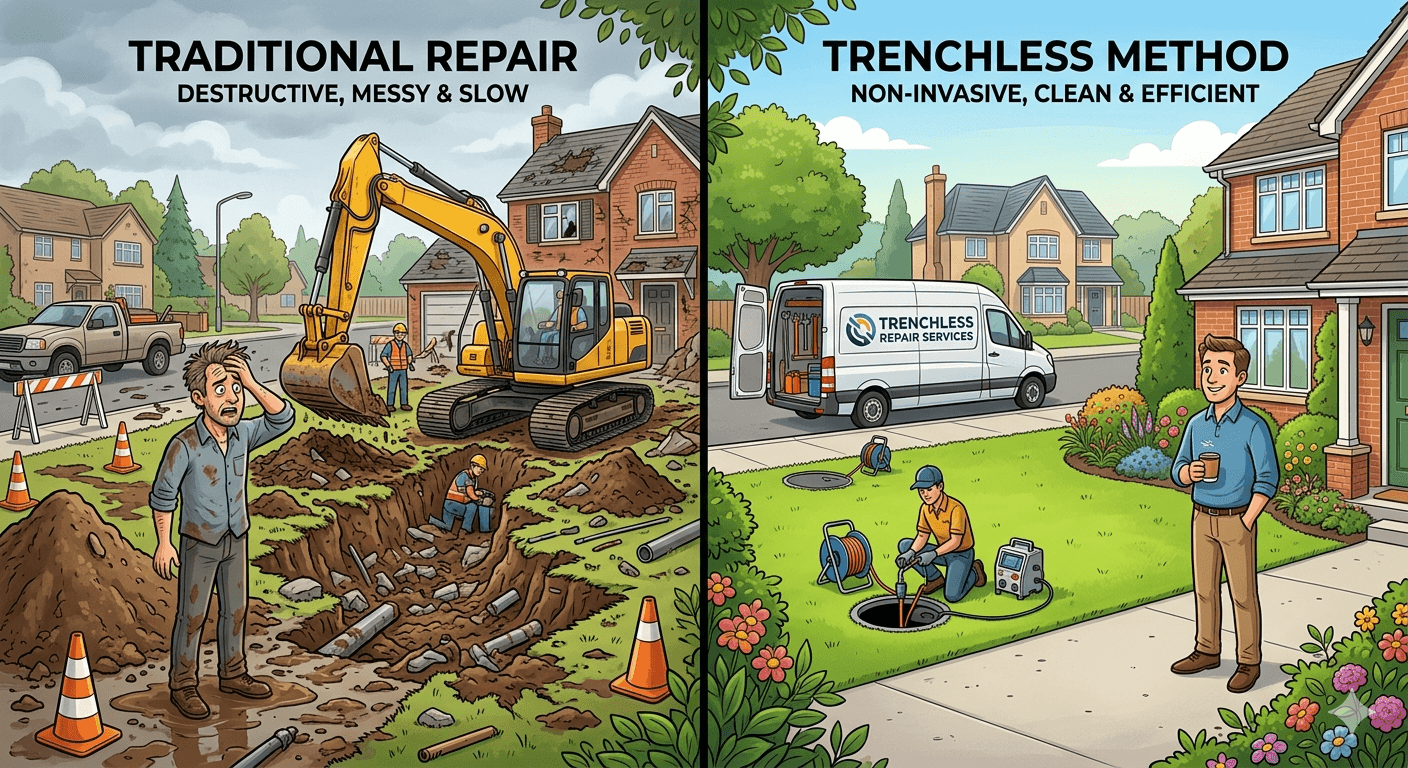
Trenchless vs. traditional: why your landscaping doesn't have to be collateral damage.
The 30-Second Gut Check: Is Your Pipe a Candidate?
Before committing to "no-dig" solutions, we must determine if the sewer line is eligible. In our experience, trenchless works 90% of the time, but that 10% requires a different approach.
Symptom-to-Action Decoder
| What you see/smell | Likely internal issue | Is trenchless an option? |
|---|---|---|
| Frequent clogs in one drain | Localized blockage or scale | Yes (after hydro-jetting) |
| Sewage smell in the yard | Small crack or joint leak | Yes (CIPP lining) |
| Gurgling toilets/slow drains | Tree root intrusion | Yes (structural lining) |
| Sinkholes in the lawn | Full pipe collapse | No (requires excavation) |
| Backups in multiple fixtures | Main line structural failure | Likely (Bursting or lining) |
The Red Line: if the pipe has completely collapsed (flat as a pancake), we cannot slide a liner through it. A shovel is the only solution there. Additionally, massive offsets—where one section of pipe has shifted significantly away from the other—might require "pipe bursting" instead of lining.
The Camera Never Lies: every project must start with a video inspection. It is the only way to distinguish a simple clog from a structural nightmare. Think of it as a medical scan for your property: we don't operate until we see the footage.
The Two Heavy Hitters of Trenchless Repair
1. CIPP Lining (The "Pipe-Within-a-Pipe")
Cured-In-Place Pipe (CIPP) involves creating a brand-new, seamless structural pipe inside the old, deteriorating one.
Our professional process follows these steps:
1. The Clean-Out: we use hydro-jetting (high-pressure water cleaning) to blast out roots and scale until the old pipe walls are smooth.
2. The Saturation: we soak a felt liner in a heavy-duty epoxy resin.
3. The Inversion: we "blow" the liner into the pipe using air pressure, turning it inside out so the resin bonds directly to the old pipe walls.
4. The Cure: we utilize modern LED UV systems (400nm light spectrum). This cures the patch in just 3-5 minutes [1]. This technology uses three times less energy and prevents scorching the liner, unlike outdated steam methods [1].
This is not a temporary "patch job"—it meets the ASTM F1216 gold standard for structural repair.
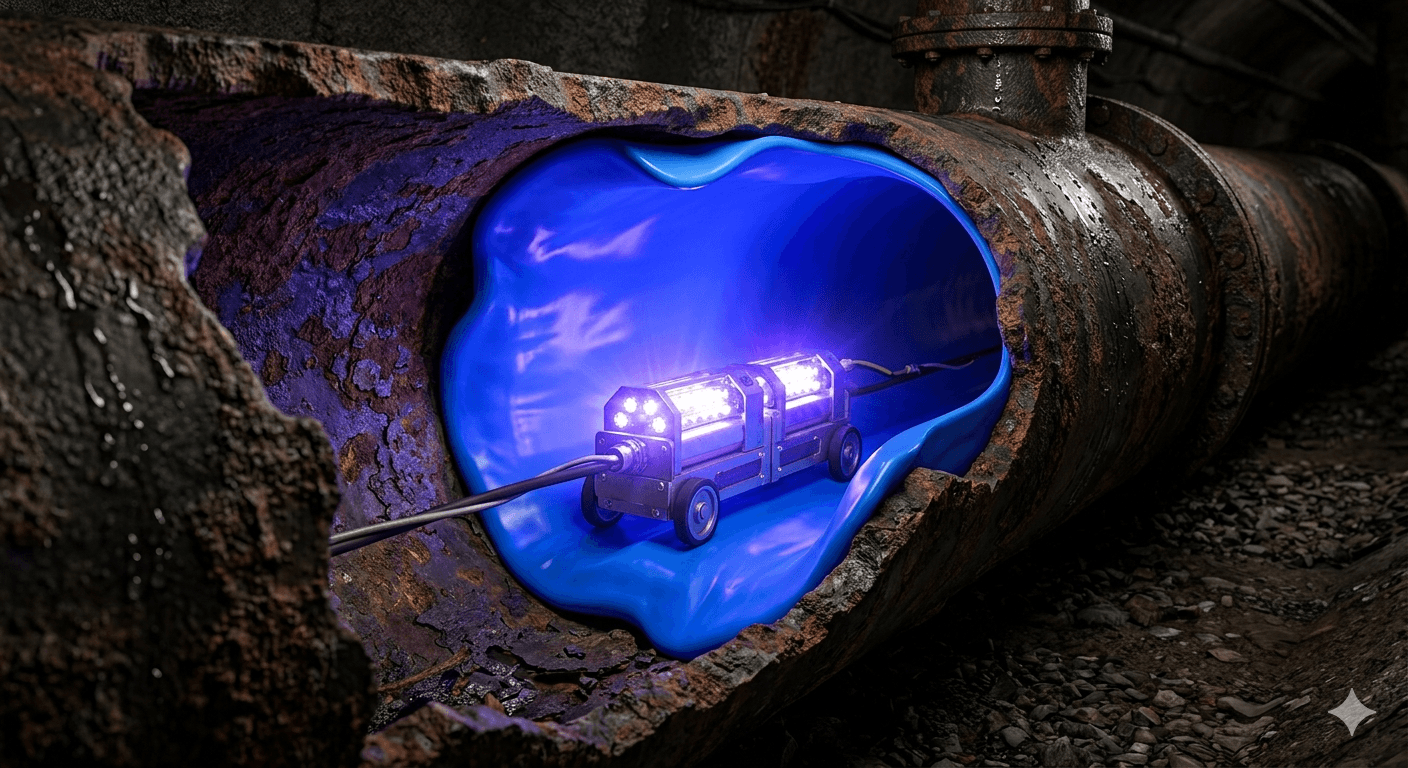
CIPP technology: we're basically building a bulletproof sleeve inside your old sewer line.
2. Pipe Bursting (The "Power Move")
If a pipe is too shattered for a liner, or if there is a need to upgrade from a 4-inch pipe to a 6-inch pipe, we use pipe bursting.
We pull a heavy, cone-shaped "bursting head" through the old line. It shatters the old clay or cast iron, pushing the fragments into the surrounding soil while simultaneously pulling a brand-new HDPE (high-density polyethylene) pipe behind it. It is fast, aggressive, and incredibly effective for severe structural failures.
Compliance & Engineering: Doing it by the Book
Technology is only as good as the installation. All CIPP work must follow ASTM F1216 for the installation and ASTM F1743 for the inspection phase [5]. For projects involving federal funding, we adhere to the BABA (Build America, Buy America) act, which requires 55% of materials to be domestic [5]. Around here, we strictly follow OSHA (Occupational Safety and Health Administration) standards [5]. Never allow a contractor to enter a trench without proper shoring and safety protocols.
Trenchless vs. Traditional: The Hard Truth
When comparing methods, we look at the "resource clock." Most people focus only on the plumbing bill, but the true cost lies in the "aftermath."
| The Factor | Trenchless (No-Dig) | Traditional (The Trench) |
|---|---|---|
| Time on Site | 4-10 hours [1] | 1-3 days of digging [1] |
| Lawn Damage | Two small access points | A 40-foot scar across the yard |
| Restoration | Minimal (grass seed) | Landscapers, pavers, concrete |
| Restoration Cost | $0 - $200 | $750 - $10,000+ [2][4] |
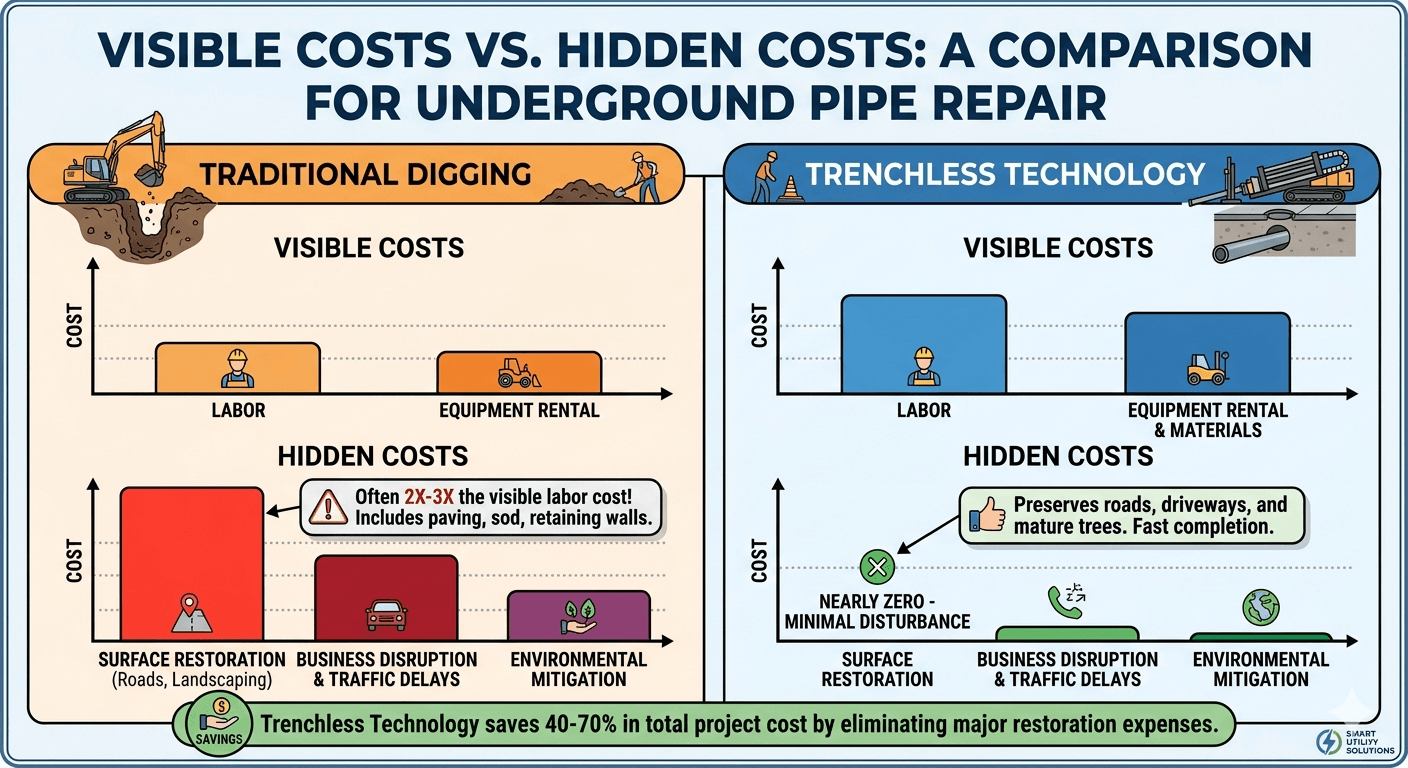
Don't be fooled by a "cheap" digging quote. the hidden costs of fixing your driveway and garden add up fast.
What Will This Cost? (2025-2026 Estimates)
Trenchless equipment is specialized and expensive, which means the "per foot" price is higher upfront.
- CIPP Lining: expect to pay $80-$250 per foot for a residential line [2].
- Pipe Bursting: usually runs $60-$200 per foot. By 2026, we expect these prices to move toward $190 for complex jobs [2].
- Traditional Digging: labor is "cheaper" at $50-$250 per foot, but you must add $75-$500 per foot just to repair the driveway or sidewalk destroyed in the process [2].
Pro Tip: always ask if the "mobilization fee" (the cost to bring the specialized equipment rig to your property) is included in the initial quote.
The Math of Reliability: Why Polymers Win
We have seen cast iron pipes rot out in 20 years in our Florida soil. Modern trenchless materials are engineered for the long haul.
- 50+ Year Life: ASTM testing and 30 years of field data show that these resins and HDPE pipes are rated for half a century of service [3].
- No Joints = No Roots: tree roots enter through the joints in old pipes. Trenchless liners are one continuous piece. No joints means no entry points.
- Chemical Proof: unlike concrete or iron, polymers are resistant to the chemicals in drain cleaners and soil acidity [3].
Seeing is believing: watch how we turn a crumbling pipe into a smooth, high-flow tunnel in one afternoon.
How to Protect Your Investment
When hiring for trenchless repair, we recommend asking for these four items to avoid subpar work:
1. The "Before & After" Video: if they don't show the finished product on camera, the job isn't done.
2. The License: in Florida, a valid plumbing license is mandatory. A machine does not make a plumber.
3. The Resin Specs: ask for the brand and ASTM standard. If they cannot name it, walk away.
4. The Warranty: a professional stands by their work for several years on labor, and manufacturers typically cover the material for decades.
What to Do Next: Your Action Plan
If you suspect a sewer failure, follow this sequence:
1. Stop the Flow: minimize water use to prevent property damage.
2. Check Your Policy: look for that "service line" coverage mentioned above.
3. Request a Camera Inspection: do not accept a quote based on guesswork.
4. Compare the "Total" Cost: ensure the quote includes both the repair and the restoration of your yard or driveway.
We understand that a sewer line issue feels like a looming disaster, but modern technology has shifted the odds back in your favor. You don't have to choose between a working toilet and a beautiful garden anymore. Take a deep breath, get the camera in the ground, and let the data guide your next move. We are here to ensure your home remains the sanctuary it was meant to be.
References
[1] CIPP LED Curing Technology & Timeframes — https://danphix.com/en/tecnologie/c-i-p-p-led-curing/
[2] Cost Comparison: Trenchless vs Traditional — https://www.advancedtrenchlesssolutions.com/blog/cost-comparison-trenchless-vs-traditional-sewer-line-repair
[3] Longevity of CIPP Trenchless Pipe Repairs — https://www.americanpipeliningsolutions.com/resource-overview/blog/the-longevity-of-cipp-trenchless-pipe-repairs-a-closer-look-at-astm-standards/
[4] Asphalt and Driveway Repair Costs 2024 — https://homeguide.com/costs/asphalt-repair-cost
[5] Engineering Specifications for CIPP — https://millerpipeline.com/wp-content/uploads/2023/09/cipp_specs.pdf